EV News
Bosch Brings Software-Defined Thinking to Trucks

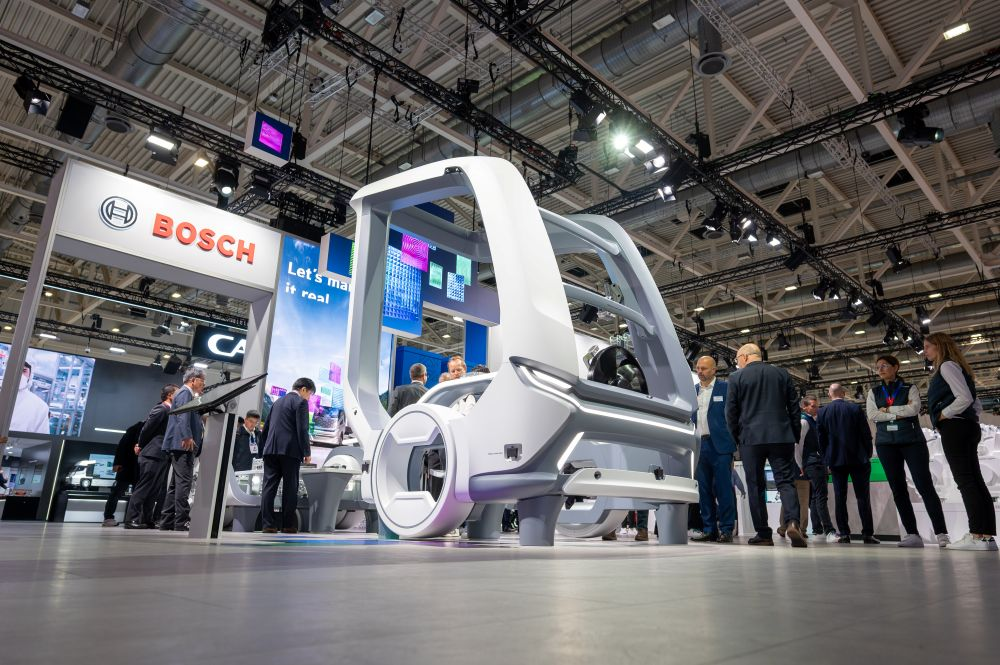
Bosch arrived at IAA Transportation 2026 with a clear message; the truck of the future will run on software. Its central vehicle computers bring cockpit, motion, energy and body functions together, allowing quick over-the-air updates. For cleaner freight, the company offers every route, from a rigid e-axle for 18 to 49-tonne trucks to fuel cell systems of up to 300 kW and hydrogen engines. Safety gets smarter too, with drowsiness detection built into digital side mirrors, an AI-powered camera and a new radar from 2027.
At the show, the company laid out its plan to bring the software-defined vehicle from passenger cars to trucks, with powerful central computers running steering, braking, powertrain and safety systems as one connected team.
According to a couple of company officials, the reason is that engineers are still making parts lighter, stronger and more efficient, but every component eventually reaches its physical limits. Steering and powertrain systems are already very advanced, so the future gains, from hardware alone will be small steps. Software, on the other hand, can coordinate many technologies inside a vehicle “with one intelligence.”
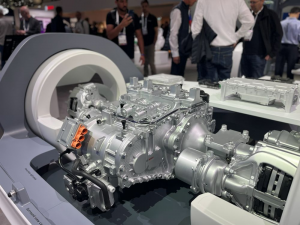
Today, almost every system in a truck has its own electronic control unit (ECU), and their number has grown rapidly. To manage this, the industry is shifting towards fewer but more powerful computers. The first step is domain and zonal architectures, in which high-performance computers (HPCs) take charge of entire areas of the vehicle, such as the body, infotainment, powertrain, braking, steering, chassis and trailer.
A single central computer may follow one day, though that is still far off. Bosch already offers its latest HPCs in passenger cars, powered by NVIDIA’s newest Thor chip, and plans to bring the same technology to trucks. This also needs faster in-vehicle networks such as Ethernet, since traditional CAN connections can be too slow, they explained.
The payoff is lower running costs. When software manages all the systems together, including battery, cabin and engine thermal management, the truck runs more efficiently, whether it is diesel, battery-electric or hydrogen-powered. The data these systems collect can also help fleet operators keep trucks on the road for longer, which matters when vehicles run around the clock.
Sharper Eyes for Safer Roads
Safety was another big focus for the company at the show. Bosch’s driver monitoring camera, the officials explained, can track where the driver is looking and spot signs of drowsiness or distraction, such as drooping eyelids, even when the driver is wearing glasses. India is expected to introduce rules requiring drowsiness detection, and Bosch aims to help customers go beyond the minimum, since driver monitoring is essential for higher levels of automated driving.
Bosch’s new Generation-7 radar can identify the difference between objects such as pedestrians and two-wheeler riders, even very close to the truck. This helps cover high-risk blind spots around large vehicles, and it could let truck makers remove the front-view mirror that some trucks still need.
Lighter, Safer and Easier to Upgrade
Fewer computers can mean less wiring and weight, but the executives said it depends on each truck maker’s approach. Some place a few powerful computers close together, which saves a lot of cabling, while others take different routes. The bigger weight savings, the team explained, come from packaging parts such as the inverter, DC-DC converter and charger into a single unit, as in an e-axle.
What happens if one central computer fails? The safety and redundancies strategy is very different and to address this Bosch has built backup in the form of Power Net Guardian, an ECU with one key job, instantly reroutes power if a fault threatens to shut down a controller or HPC. Safety-critical software runs in more than one place, and Bosch’s electric power steering has four layers of redundancy, so a truck can still steer even if the steering column connection is lost.
Software-defined trucks are also easier to upgrade. A layer of middleware sits between the hardware and software, so truck makers can add new features later, such as cyber intrusion detection, often without changing the hardware.
Every Powertrain on the Table
Bosch is not betting on a single fuel. On its stand were a battery-electric setup with a rigid e-axle, power electronics and a battery disconnect safety unit, along with its latest-generation fuel cell power module. Rated at 300 kW, the module combines the fuel cell stack and all supporting systems in one unit, effectively replacing the engine, and its only exhaust is water.
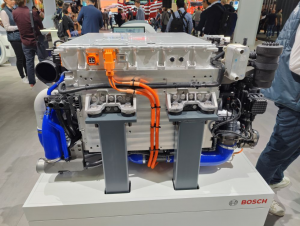
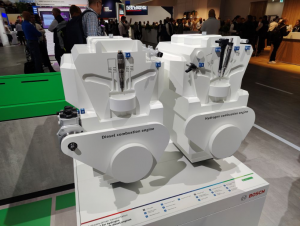
Bosch is also developing the diesel engine to meet Europe’s upcoming Euro 7 rules. Alongside it displayed a hydrogen combustion engine that is almost identical to the diesel from a powertrain standpoint, with the hydrogen tank being the key addition. It also supplies the high-pressure tank systems that store hydrogen and feed it to the engine.
In India, Bosch is working with the Ministry of New and Renewable Energy on a pilot project for hydrogen trucks and has supplied samples to Tata Motors, though progress has been slower than hoped.
The thinking behind this broad range is that no single solution fits every region or application; therefore, Bosch wants to support all of them and let truck makers choose what works best for their customers.