EV News
Mahindra Last Mile Mobility Reinvents Electric L5 Passenger Mobility with UDO

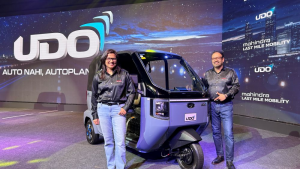
Mahindra Last Mile Mobility has unveiled the Mahindra UDO, an all-new electric three-wheeler that marks a decisive shift in the evolution of India’s L5 passenger carrier segment. With an introductory price of ₹3.58 lakh (ex-showroom), the company is positioning the UDO not merely as a product upgrade, but as a category reset: combining long-range capability, premium comfort, aircraft-inspired design and a strong total-cost-of-ownership proposition.
At a time when electrification in the three-wheeler space has already crossed the 30–35 percent mark, the UDO targets the next wave of customers those requiring higher daily running and faster trip turnaround, while also elevating the driver’s working environment and professional identity.
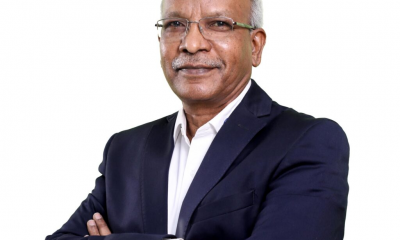
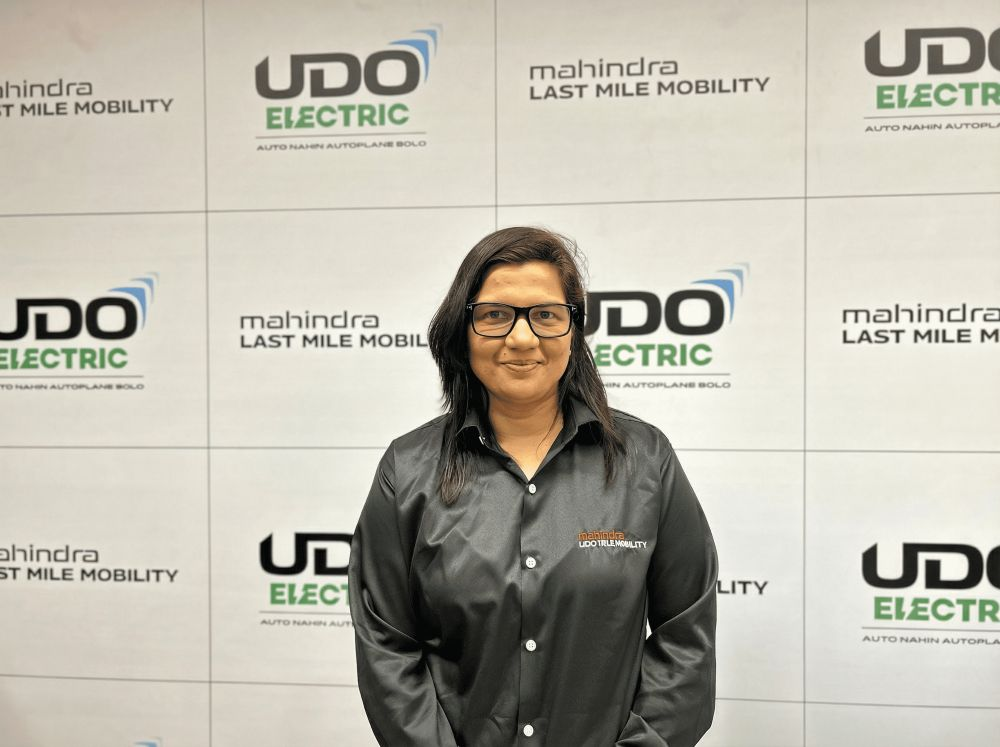
“At Mahindra Last Mile Mobility, our purpose is to electrify last-mile transportation in a way that meaningfully improves customers’ lives. The UDO is built on deep insights into how drivers earn, operate and experience their vehicles every day. We wanted to move the segment from survival to dignity through better safety, superior comfort, strong performance and aspirational design. This is not an incremental upgrade; it is a ground-up reimagination of what a three-wheeler can be and what it can represent for its owner,”said Suman Mishra, Managing Director & CEO, Mahindra Last Mile Mobility
Aircraft-Inspired Design that Seeks to Create a New Segment
The UDO’s most striking differentiator is its design philosophy. Developed by the Mahindra India Design Studio under Pratap Bose, the vehicle adopts an “autoplane” concept, with a monocoque body, large glass areas, strong road presence and a highly ergonomic cabin.
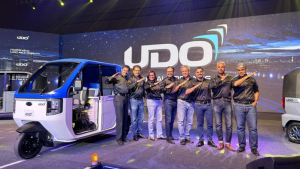
The approach was to bring passenger-vehicle learnings into a commercial three-wheeler without compromising cost, durability or serviceability.
“This was an opportunity to disrupt a format that has remained largely unchanged for over 75 years. In commercial vehicles, the functional requirements are different, but the emotional needs of the driver being visibility, comfort, pride of ownership, are exactly the same. We enlarged the glass area dramatically, improved ergonomics, introduced automotive-grade materials and even elements like DRLs. The intent was simple: to elevate the status of the operator and create a design language that can define this segment for years,” explained Pratap Bose, Chief Design & Creative Officer – Auto & Farm Sectors, Mahindra & Mahindra
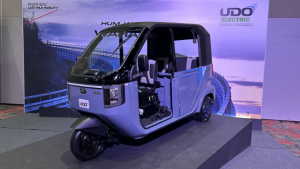
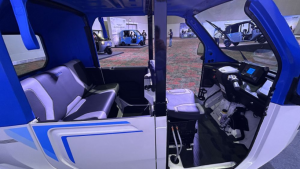
Inside, the vehicle features a thicker “pilot seat” for the driver, lounge-like passenger space, generous legroom and headroom, independent rear suspension and dual-fork front suspension which are elements rarely prioritised in the category.
Built for High Daily Running and Faster Earnings
The UDO delivers a 200 km real-world range (265 km ARAI) powered by an 11.7 kWh IP67-rated battery and a 10 kW motor. With Range, Ride and Race drive modes, regenerative braking and a segment-first reverse throttle, it is engineered for operators who regularly exceed 150 km per day.
The higher top speed and reduced braking dependency directly translate into more trips per shift and higher earning potential.
“Use case clarity is critical in this segment. Customers who run 100–150 km a day will continue to find our existing products extremely relevant. But for those who regularly cross that threshold, range becomes income. That is exactly where UDO fits. It allows faster turnaround, more trips and better daily economics, while still keeping the charging simple through a standard 16-amp home socket,” Suman Mishra stated.
Manufacturing Scale and a ₹1,000-Crore Telangana Commitment
The UDO is built at Mahindra’s Zaheerabad facility, which is being scaled as a dedicated EV manufacturing hub. The product itself represents an investment of over ₹500 crore, with the broader Telangana roadmap touching ₹1,000 crore.
The plant is future-ready, with battery assembly, robotic lines and capacity planned for up to two lakh vehicles annually, enabling both domestic growth and exports.
“We have invested not only in the product but in the entire ecosystem – battery lines, body shop, R&D and manufacturing automation. Capacity is being built ahead of demand because electrification in this segment is structural, not cyclical. While our immediate focus is India, the product has been engineered with export markets in mind, and homologation will unlock those opportunities progressively,” she said.
Financing, Permits and the Post-Subsidy Reality
With demand-side subsidies now phased out, Mahindra’s strategy hinges on scale-led cost reduction, strong TCO and deep financier engagement. The company has pre-aligned lenders so customers can access funding at the dealership itself.
“Subsidies have tapered from ₹1 lakh to zero, yet electrification has continued to grow. That tells you the economics are fundamentally strong. Today financiers approach us because asset quality and customer earnings are proven. Our job was to price the UDO so the down payment remains accessible and approvals are seamless. For the customer, lower running cost and daily savings are the real incentive, not subsidies,” she stated.
Platform Strategy and Future Derivatives
The UDO has been developed as a modular platform, opening the door for wider body formats and cargo applications, while retaining common driver-centric improvements in comfort and design.
“Passenger and cargo requirements differ in load versus comfort priorities, but the driver experience and the design philosophy can absolutely carry forward. That is why we built this as a modular architecture. It gives us the flexibility to derive multiple products while keeping development time and cost efficient,” she explained.
Market Outlook: 50% Electrification in Sight
Mahindra expects the L5 category to move towards 50 percent electrification within the next two to three years, driven by superior operating economics and ease of home charging.
Metro adoption, however, will depend on higher-range products like the UDO, as current electrification in large cities remains relatively low.
“This customer base is among the most EV-savvy in the country. They understand charging, maintenance and savings better than most passenger-vehicle buyers. When your daily operating cost drops and your income potential rises, adoption becomes a business decision, not an environmental one. That is why electrification has reached 35% already and it will continue to accelerate,” she said.
Design as a Demand Generator
Mahindra believes the UDO’s visual identity and cabin experience will influence customer preference, even at the passenger level.
“When we launched our recent BEVs, we didn’t just enter a segment, we created one. The brief here was similar: build something so distinctive that people ask for it by name. Even if a passenger is not buying the vehicle, they will choose to ride in it. That pull effect is what turns a product into a category benchmark,” Pratap Bose stated.
With industry-first features, a long-range architecture, strong financing readiness and a design-led value proposition, the Mahindra UDO is aimed at expanding, not merely competing within, the electric three-wheeler market.
By combining earnings logic for the operator with aspiration and dignity, Mahindra is attempting to move the segment into its next phase, where electrification is no longer the differentiator, but the baseline.