EV News
Seven European CV OEMs Unite, Call for 2030 CO₂ Target to Be Delayed to 2033

For the first time ever, seven CEOs from Europe’s leading truck and bus makers stood together on one stage, representing 97% of the European market, with a joint appeal: push the EU’s 2030 CO2 targets for heavy-duty vehicles to 2033. If the 2030 target is missed, the fines are severe – around €120 million for every percentage point missed. For instance, if a company only achieves a 33% reduction instead of the required target, falling short by 10%, that’s a whopping €1.2 billion penalty, roughly what Mercedes-Benz Trucks earned globally in all of 2025. For the industry, this is not a minor inconvenience, it is existential, Ms. Rådström, Chair of the ACEA Commercial Vehicle Board and President & CEO, Daimler Truck Holding AG, pointed out. Penalties won’t solve any of these problems, they won’t build a single charging station or make electric trucks more affordable, they’ll simply divert billions of euros away from the investment needed to keep Europe’s global leadership in this sector.
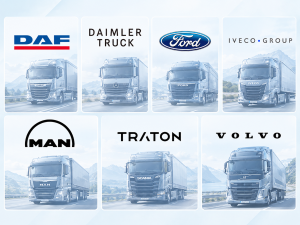
The CEOs participated in the conference include Mr. Jim Walenczak, President of DAF Trucks; Ms. Karin Rådström, Chairwoman of the Board of Management of Daimler Truck and Chairperson of the ACEA Commercial Vehicle Board; Mr. Güven Özyurt, CEO of Ford Otosan; Mr. Olof Persson, CEO of Iveco Group; Mr. Alexander Vlaskamp, CEO of MAN Truck & Bus; Mr. Christian Levin, President and CEO of Scania Group and TRATON GROUP; and Mr. Martin Lundstedt, President and CEO of Volvo Group.
Elaborating the need to push the target, Ms. Rådström said the industry fully supports Europe’s zero-emission goals under the Paris Agreement and Green Deal, and stressed that the products are already ready. Manufacturers have delivered more than 60 zero-emission truck models and over 25 zero-emission bus models across brands. But despite this, only 2% of heavy-duty trucks registered in Europe last year were electric, rising slightly to 2.2% in the first half of this year. With just three and a half years left until 2030, when 35% of newly registered trucks must be zero-emission, the gap between where the market stands today and where it needs to be is enormous.
Twin Barriers
She said customers aren’t holding back because the trucks aren’t good enough, but because of two real barriers: charging infrastructure and cost parity with diesel. Getting a grid connection for a charging site in Europe today can take up to seven years. Under the EU’s Alternative Fuels Infrastructure Regulation, member States need to install 500 truck-suitable charging points every month to meet the 2030 target of 20,000 dedicated charge points. Right now, Europe has fewer than 2,000 such charging points in total, meaning only about 50 have been installed per month since the regulation was agreed in 2023.
On cost, she said the business case simply isn’t there yet for many customers, since electricity prices in Europe remain far higher than in markets like China, making it harder for electric trucks to compete with diesel on a cost-per-kilometre basis. She said tools like CO2-based road tolling (charging vehicle operators a distance-based fee scaled directly to their carbon dioxide emissions) could help close this gap, but only 13 of 27 EU member States have implemented such tolls so far, and fewer than a handful of those actually differentiate meaningfully between diesel and electric vehicles.
Why a Three-Year Delay, and Why It Matters
ACEA Chair argued that under the current framework, manufacturers alone carry full responsibility for hitting the 2030 targets, despite having no control over the very factors holding the transition back such as building infrastructure, granting grid connections, setting energy prices, or introducing toll exemptions. Instead, she called for what she described as “the speed of right”, the right decisions, made at the right pace, outlining three priorities. First, Europe must urgently scale up charging infrastructure to at least 500 new charge points a month. Second, the CO2 regulation review should be tied to other supporting regulations like Alternative Fuels Infrastructure Regulation (AFIR) and the Eurovignette (a user fee for certain motorways in some European countries) and third, unless drastic action is taken on infrastructure immediately, the 2030 deadline itself needs to shift to 2033.
Later, replying to queries from the media, the executives clarified that what matters is removing the threat of fines so manufacturers can plan investment cycles and supply contracts with confidence. No one wants half-empty factories or stranded assets. The real ask, they said, is to simply link the pace of electric vehicle adoption to the actual pace of infrastructure development, something the original legislation should have done from the start. One executive added that even if a policy review happens quickly, actually adopting new measures could take another 12 to 18 months, which is exactly why decisive action is needed soon, since every month of delay compounds the timeline problem.
Ready to Scale, If Europe Delivers
Mr. Lundstedt said the industry stands ready the moment governments deliver their side of the bargain, upgraded infrastructure and emissions trading systems in place. He pointed to the trade show floor itself as proof, where lots of electric trucks were exhibited by almost all the European OEMs; these aren’t prototypes or pilot projects, they’re production-ready machines, built on years of serious capital investment. The ask, he said, “isn’t a favour, it’s a fair trade, which is to give the industry working conditions, and industry will scale up fast.”
To a question on battery-swapping technology, the executives said the industry remains genuinely open to exploring multiple technologies and business models. They noted battery swapping is growing quickly in China, but cautioned that running two parallel systems, swapping and standard charging, creates real complexity. Either way, they said, both approaches ultimately depend on the same underlying need – sufficient grid capacity and energy availability.
Payload Loss and Distribution Vehicles
Heavy battery packs reduce how much cargo a truck can legally carry, sometimes by one to four tonnes. To this the executives confirmed this has been one of the industry’s earliest and most persistent requests to the EU, asking regulators to compensate for this payload loss. Some progress has been made, but the issue remains unresolved, directly excluding certain markets, like heavy liquid or bulk transport, that require trucks to carry cargo up to legal weight limits.
A related question asked was why the original regulation focused on heavy, long-haul trucks rather than smaller distribution vehicles, which need far less charging power and could arguably have been electrified faster. To this the executives explained that while individual distribution trucks, garbage trucks, delivery vans, and similar vehicles do work fine on lower power charging, the real problem emerges at scale. When a depot needs to charge 100 or 200 trucks simultaneously, existing grid connections simply can’t handle it, forcing operators to rely on alternatives like biogas instead. They noted this exact challenge, how to manage a coordinated, system-wide shift, was central to negotiations from the very beginning, and remains largely unresolved today.
Missing the Bus
Won’t delaying the CO2 targets by three years let Chinese and American rivals pull ahead and Europe missing the bus? The CEOs disagreed; they said the real issue isn’t competition, it’s trust. Customers need confidence that charging infrastructure and fair pricing will actually be there before they switch to electric trucks. The CEOs said they want a level playing field, driven by real demand, not government subsidies favouring any one player. In the end, they said, the best product should win, and Europe’s manufacturers are ready to compete on that basis.
The top executives concluded that commercially they remain fully committed to the transformation, and real progress is already happening on the ground. But the pace of real-world change simply isn’t keeping up with regulatory deadlines. The solution, they said, requires action on two fronts simultaneously – accelerating the enabling conditions, like infrastructure and energy pricing, while also adjusting the CO2 compliance timeline to reflect what the market can realistically absorb.